Licensed Canadian
Customs Broker —
Nationwide Customs Clearance.
Ambassador Customs Brokerage helps businesses and individuals import goods into Canada quickly and efficiently. Our licensed Canadian customs brokers ensure fast, compliant, and stress-free customs clearance nationwide.
Licensed & Trusted
Licensed Canadian Customs Broker
Nationwide Coverage
Across all major ports and borders
Flat Fees
Transparent pricing with no hidden charges
Fast & Reliable
Quick clearance and on-time releases
Expert Support
Personalized service from experienced brokers
What we do, lane by lane.
Four core services — CBSA submissions, flat-rate brokerage, CARM compliance, HS classification.
Import to Canada Made Simple
Importing goods into Canada doesn't need to be complicated. We manage CBSA requirements, documentation, and communication with carriers, so you can focus on running your business.
Flat Brokerage Fees with No Hidden Charges
Customs clearance should be predictable. Ambassador Customs offers flat brokerage fees with no hidden costs, helping importers save money and plan with confidence.
Expert Guidance with CARM & RPP Support
CARM onboarding and RPP bonds are now essential for all Canadian importers. Our experts guide you through registration, bond setup, and compliance with CBSA regulations to avoid penalties and delays.
HS Code Classification & Trade Compliance
Accurate HS code classification ensures the correct duties and taxes are applied. Our team helps importers verify HS codes, reduce risks of errors, and maintain full compliance with Canadian trade regulations.
Serving Importers
across Canada.
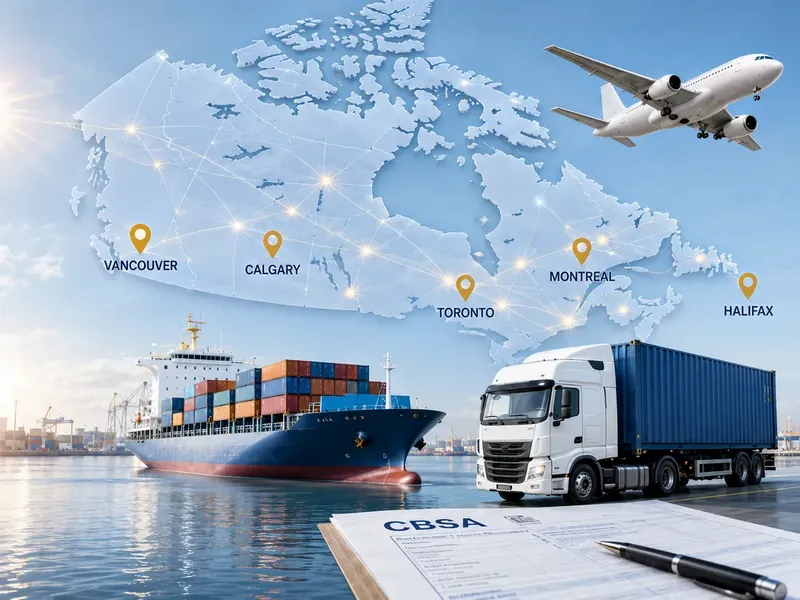
Ambassador Customs Brokerage supports customs clearance services at major Canadian ports of entry nationwide. Whether shipments arrive by air, ocean, rail, or truck, we coordinate with CBSA, carriers, freight forwarders, and warehouses to help keep shipments moving efficiently across Canada.
Toronto
One of Canada's largest commercial import hubs and a major gateway for international cargo. Ambassador Customs Brokerage coordinates customs clearances for shipments arriving through the Greater Toronto Area, including air cargo, e-commerce inventory, commercial freight, and imports moving through bonded warehouses and distribution networks.
Vancouver
A major gateway for Asia-Pacific trade and one of Canada's busiest ports for international cargo. Ambassador Customs Brokerage supports customs clearances for ocean freight, air cargo, rail shipments, and commercial imports arriving through the Vancouver region, including containerized freight from Asia and trans-Pacific supply chains.
Montreal
One of Canada's primary eastern gateways for international trade and commercial imports. Ambassador Customs Brokerage supports customs clearances for ocean freight, air cargo, and ground shipments arriving through the Montreal region, including imports from Europe, the United States, and international supply chains serving Quebec and Eastern Canada.
Calgary
A major logistics and transportation hub for Western Canada and an important gateway for industrial and commercial imports. Ambassador Customs Brokerage supports customs clearances for air cargo, rail shipments, truck freight, and commercial imports moving through the Calgary region and Western Canadian supply chains.
Halifax
An important Atlantic gateway for international trade and commercial imports into Eastern Canada. Ambassador Customs Brokerage supports customs clearances for ocean freight, air cargo, vehicle imports, refrigerated shipments, and commercial cargo arriving through the Halifax region and Atlantic Canadian supply chains.
Don't see your port listed?
Ambassador Customs Brokerage supports customs clearances at CBSA offices and ports of entry across Canada, including Ottawa, Winnipeg, Edmonton, Quebec City, Saint John, and other regional locations. Contact our team to discuss your shipment and customs clearance requirements.
Contact Our Team →Why Businesses Choose Ambassador Customs.
Four reasons importers across industries, ports, and shipment sizes choose to work with us.
Licensed Canadian customs broker
Nationwide coverage: ports, airports, and border points
Flat fees, no hidden charges
Experience across industries and product categories
Start Your Import today.
Ready to clear your shipment? Complete our simple Account Setup Form, and let us handle the rest.
Frequently Asked Questions.
The conversations we have most often, indexed for quick reference.
How long does customs clearance take in Canada?
What causes customs delays in Canada?
- Missing or incomplete documentation
- Incorrect HS classification
- Incorrect declared values
- Missing CARM registration or broker authorization
- Government agency requirements (CFIA, Health Canada, Transport Canada, etc.)
- Shipment inspections or carrier-related delays
How can I avoid customs delays?
- Provide accurate product descriptions
- Use correct HS classification codes
- Submit complete shipping and commercial documents
- Ensure proper declared value and country of origin information
- Confirm any required permits or government agency approvals in advance
What documents are required to import goods into Canada?
- Commercial Invoice or Canada Customs Invoice (CCI)
- Bill of Lading (BOL), Air Waybill, or shipping documents
- Notice of Arrival (NOA) or eManifest information
- HS classification codes
- Country of origin information
- CUSMA/USMCA origin certification, if applicable
- Any required permits or government agency documentation depending on the product type
What is PARS?
What is an HS code and why is it important?
What is a Notice of Arrival (NOA)?
Is the account setup process complicated?
Can you clear shipments from UPS, FedEx, and DHL?
How do I start importing into Canada?
- Register in CARM
- Obtain a Business Number (BN) import/export account
- Prepare commercial import documents
- Set up an account with a customs broker
- Arrange shipping
- Once goods are released by CBSA, arrange pickup or final delivery with the carrier or warehouse